top of page
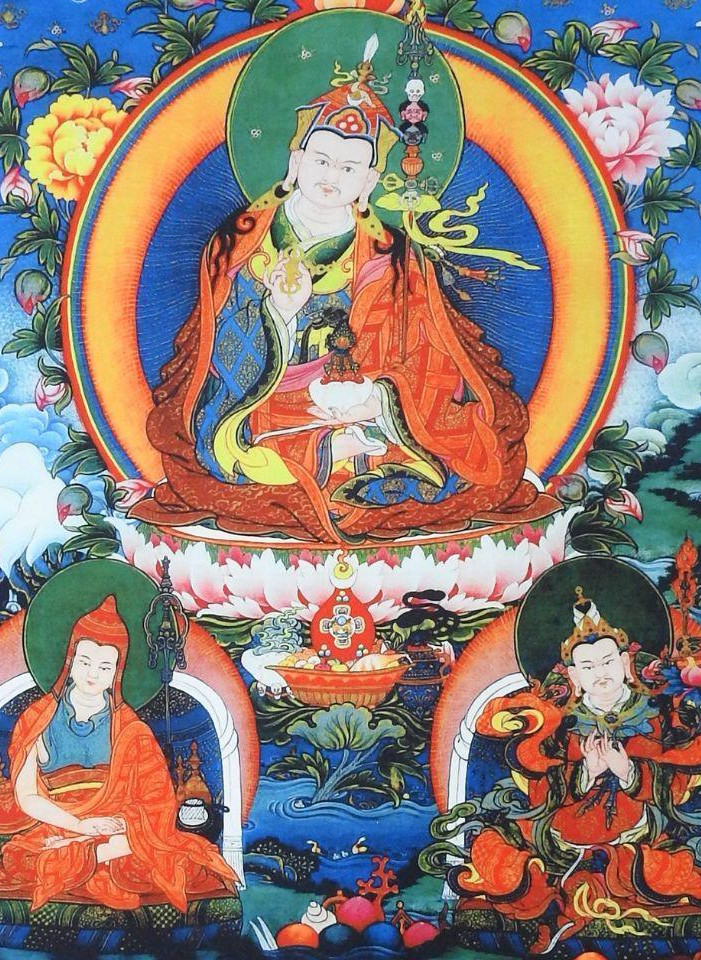
In order to benefit all sentient beings, after he attained enlightenment and until his Parinirvana, the historical Buddha Shakyamuni compassionately turned the wheel of Dharma and expounded numerous teachings. In order to accommodate the different temperaments and intellectual capacities of his disciples, he extensively and skilfully gave teachings openly to vast assemblies, small groups, as well as private teachings to individuals.
His First Sermon explained the Four Noble Truths and the Noble Eight-Fold Path which laid the ground of all spiritual development. This first teaching was given to the common beings and it attracted a vast assembly. His Second Sermon emphasised more on emptiness and compassion. This teaching was given to the Bodhisattvas. The Third Sermon, a more elaborate teaching, with emphasis on Buddha nature, was given to the Bodhisattvas who have sharp intellect and were capable of understanding the ultimate truth.
Altogether, there are 84,000 heaps of teachings from his discourses; each of them serves as an antidote accordingly to our 84,000 defilements. It is said that 21,000 heaps of them are antidotes for the defilements of attachment, 21,000 heaps for the defilements of hatred, 21,000 heaps for the defilements of ignorance, and 21,000 heaps for the defilements of attachment, hatred and ignorance together.
However, all these teachings are also broadly classified into 3 categories, namely, 1) Theravada School, the teachings which emphasised on moral discipline and ethics and the Mahayana School, comprising of 2) Sutrayana teachings and 3) Tantrayana teachings. Sutrayana is a gradual path to perfect the causes of enlightenment. Its teachings focus on the practices of the six perfections, compassion and loving-kindness towards all sentient beings. It is also known as the causal path and could take as long as three great eons to attain enlightenment. Tantrayana also known as Vajrayana or Secret Mantrayana, elaborates on the ultimate truth and has the quality of bountiful profound methods. Under the skillful guidance of an authentic teacher with pure lineage, the Vajrayana practitioners can attain the fruition of enlightenment. Thus it is also known as the path of result. It also has the unique qualities of effortlessness and swiftness which means that practitioners can attain the supreme enlightenment effortlessly within a short period of time, even as short as within one's lifetime, as compared to Sutrayana.
To be able to learn and practise this kind of profound teachings, three conditions have to be present: the disciple must be of sharp intellect, the master must be a skilful enlightened being, and the teachings must be introduced according to each disciple's level of acceptance. Among the followers of Mahayana, Lord Buddha taught the Vajrayana teachings to only a handful of people who possessed the special qualities of the Vajrayana vessel. Basically, Vajrayana emphasises individual practice; therefore it is not communal to everyone. Nonetheless, Lord Buddha prophesised that many other enlightened noble beings would appear in this world and widely spread the Vajrayana teachings.
Therefore, it is without dispute that Vajrayana is an authentic Buddhist teaching, which is no different from the other two schools, even though it was not openly taught by the Buddha and it is less well known by the vast congregates. Although the source of Vajrayana originally sprung from the noble land of India, the continuation of its lineage is no longer in India. Authentic Vajrayana practice can only be found in Tibetan Buddhism today.
The teaching lineage preserved in Tibetan Buddhism, as an exceedingly rich and profound literature of 102 volumes Kagyur texts, written in Sanskrit. It consists of 40 volumes on Sutra; 31 volumes on Sutrayana and 31 volumes on Vajrayana. All these scriptures were directly expounded by the Buddha himself. They are categorised into 3 divisions, known as Tripitaka or Three Baskets, encompassing Vinaya, which are teachings on moral discipline and ethics; the Sutras, which are the discourses given by Buddha on the teachings of developing the meditative concentration, and the Abhidharma (literally meaning flowing into the direction of reality), which consists of teachings on the discussions of Buddhist philosophy or metaphysics, for the development of ultimate wisdom.
Based on the teachings of the Kagyur texts, great masters and scholars composed extensive commentaries, in the aim to elucidate the essence of the teachings so as to facilitate a translucent understanding for future generations. All these commentaries as well as lots of other important Buddhist works were collected and organised into more than 200 volumes of Tengyur texts. Apart from these, great volumes of literatures by renowned Tibetan masters on teachings of Vajrayana as well as other teachings transmitted from India, and thousands of commentaries that are based on these teachings still remain intact. The entire teachings were precisely translated into Tibetan by all great Tibetan and Indian masters. Due to the contribution of their commendable and selfless efforts, Buddhism spread widely throughout the land of Tibet and flourished until the 20th century.
The lineage of Tibetan Buddhism could be traced back to as early as the seventh century during the time of Tibetan king Songtsen Gampo. However, it only began to flourish in the 8th century when King Trisong Detsen, who is believed to be the manifestation of Manjushree, invited the Indian sages Padmasambhava and Shantarakshita to Tibet. Out of his utterly devoted heart towards the Dharma, he commanded many important texts to be translated into Tibetan. Teachings in this period are mainly known as the Nyingma Tradition or Old Tradition.
However, this fortunate joyful era was later nearly devastated by an anti-Buddhist Tibetan King, Langdarma. After his period of ruling and in the 11th century, a new system of Buddhist classification was introduced and new traditions known as the Sarma traditions were established during this period. It was during this period that the shoots of Tibetan Buddhism started to sprout again. Kagyu, Sakya, and Gelug belong to the new traditions. All schools and lineages of Tibetan Buddhism shared the common lineage of the Pratimoksha Vows according to Sarvastavada (Tib: Zhi Tham Ched Yod Par Ma Wa) and Sthaviravada (Tib: Ne Den De Pa), as well as the Bodhisattva Vows.
For centuries, these teachings have streamed down from generation to generation, through the qualified masters of the individual lineages to their worthy disciples. These arrays of lineage masters were not just simply scholarly but were fully realised individuals who had personally practised and mastered the teachings that they had received from their masters. Therefore, authentic transmission of the lineages is being preserved and undistorted.
Light-rays spread out in multi-folds of directions and they may transform due to different conditions. Nonetheless the main source of light is none other than the brilliant sun itself. Likewise, it may seem that there are diversities of schools and lineages while in actual fact they are no different from the compassionate and skilful displays of the Lord Buddha.
Deepen Your Connection
Email Us
info@karmakagyuds.com
Visit the Center
Karma Kagyu Dharma Society Kuala Lumpur
No 2, Lorong Jubilee off Jalan Loke Yew. 55200 Kuala Lumpur, Malaysia
Call Us
Tel: +603 9222 1540
Fax: +603 9221 9810
bottom of page